Though my journalistic writing has been sparse, mainly during undergraduate, I have written across a handful of different subjects, and have been awarded at the state level for coverage.
Queer athletes find haven in club sports amidst inclusivity policy reversals
Editors Note: All interviewees asked to remain anonymous and have chosen pseudonyms.
Amidst nationwide DEI dismantling, more and more safe spaces on UNC Charlotte’s campus have begun to shutter and dial back their activities. On the other hand, club sports continue to provide a place of community and encouragement for campus athletes from all backgrounds.
Club sports at Charlotte: a sense of relief
At UNC Charlotte, there are 37 active club sports organizations, serving 1,881 students, with 1/3 of those students identifying as women. Club sports provide athletes a way to continue playing the sport they love, even if outside factors are at play.
For some, those outside factors lead to a sense of disillusionment in the sport they love.
Celia, a third-year club field hockey player, was initially preparing to play Division 1 (D1) in the NCAA, but after being sidelined for a year due to a hand injury, was unable to pursue a D1 athletic career. After stepping away from athletics for a period of time, she decided to join Charlotte’s club field hockey team in the fall of 2023.
Celia spoke extensively about the pressures not just of D1 athletics but of sports in general and the relief that club sports can provide.
“I think people are drawn more to club sports because a lot of people lose their love for a sport when there is so much pressure put on them,” said Celia. “I feel like club sports takes away that pressure while still being able to enjoy the game without having all the pressure of being an NCAA athlete.”
Response to DEI removal
Although the DEI-related policies and new guidelines do not directly affect club sports’ funding or operations, some athletes are worried about the effect of institutional neutrality and the possibility of further rollbacks in the future.
“I worry that since we’re [Charlotte] going to be a neutral institution, we might not be able to advocate as much as we do for queer athletes,” said Celia. “It just worried me that we could [if things change] get in trouble with the University for, say, if we had a pride game or a game that focused funds to a local LGBTQ+ organization.”
Charlotte is a diverse school, which is also true of club sports. As a result, the notion of further DEI cuts and Charlotte’s move towards institutional neutrality can feel discouraging for some.
“I think DEI is a really important thing that we need to have,” said Celia. “Seeing the [DEI] rollbacks, especially as a political science major, has been crazy because so much of my academic field has been focused on identity, culture and peace studies.”
Delilah, a second-year club athlete, has been involved in sports since seventh grade and has seen the effects of these DEI rollbacks elsewhere in the University, including a friend of hers having a grant cut for her research on LGBTQ+ topics.
“They [Charlotte] just cut the grant, so they don’t have it anymore. It’s just like, what’s the point?” said Delilah. “Where are you putting that money instead? You’re not using it for good. You’re just taking it away.”
Club sport experience as a queer athlete
For many, college is a time when they can come to terms with who they are. In that vein, club sports have become a safe haven for some, with the team environment spurring their own journeys.
“I kept that part of myself [bisexuality] closed off for so, so long, especially in high school, and coming to Charlotte and joining the team changed my mindset on closing that part of myself off,” said Celia. “I feel like I’m in an environment where I can finally be myself, and I’ve definitely become more comfortable with that part of myself over the last two years.”
Growing up in the South, Christina had not experienced being on a team with openly queer athletes until she came to Charlotte and met players who were from Northern states, such as New York or New Jersey.
“They [Northern players] were like, ‘Oh yeah, half my club team was gay,’ and I was like, ‘Y’all were telling people?’” said Christina. “I look back at my [high school] club team, I probably was the one [queer] person, and people didn’t even really know because I didn’t tell them.”
“Once I got to college, I felt that I was able to reinvent myself a little bit, just being more honest with people,” added Christina.
A shared perspective among athletes to describe club sports was that it is a ‘support system.’ Whether it acts as an escape from the grueling hours of academics, stress in someone’s personal life or worries about the world, club sports have allowed these athletes to shake off the weight of the world for a time.
“Even if we have a bad practice or we have a bad game, you show up every Monday and Wednesday [for practice], you clear everything that’s going on in your mind, you go, you play and everything feels okay for two hours,” said Celia. “The world might be falling apart, but in that moment, everything is okay.”
Christina disclosed that when she was outed to her family, the first people she texted were her teammates, and she felt incredibly supported by her fellow players, regardless of sexual orientation.
“Even though maybe they [teammates] are straight, and they weren’t experiencing that, they heard about it, and they were like, ‘Oh my gosh, I just want you to know, I’ve been thinking about you all day,’ that sort of thing,” said Christina.
Although there are worries for the future, the players are steadfast in their love for athletics and their teams, unwavering in their beliefs.
“[I hope] we don’t ever let anyone tell us to change because our team environment is so special, the family we’ve built is so special, and I don’t want anybody to ever ruin that,” said Celia.
Gearing up to graduate, Christina wants to make sure her legacy is a sustainable one, declaring that “in 10 years, I want people to have never heard of us [team founders], and they are completely running the team, doing everything they need to do, not really needing any help.”
Amidst times of adversity, Delilah emphasized the importance of resilience and comradery in environments such as club sports.
“The power of sports and community is so much greater than what the government is doing right now, and even though it hurts to see people try to take that [DEI] away from us, I can come to sports as my coping mechanism,” said Delilah. “So, I do have hope in our generation and our sports community that we can come back from these rollbacks.”
‘Charlotte is a place to learn’: Professors and students navigating a world that gravitates towards AI
In the midst of her sabbatical, Dr. Kefaya Diab noticed that the College of Humanities & Earth and Social Sciences (CHESS) was hosting an AI Week, bringing together various faculty from across the college to present and discuss their views and knowledge on artificial intelligence in the humanities.
A pre-tenured professor at UNC Charlotte, Diab initially wanted to preserve her energy to tackle her own research, ensuring that her sabbatical would produce the work she had set out to do.
But, while reflecting on her position as a rhetorical scholar, she felt a responsibility to throw her hat in the ring, to show the nuance that her field could bring to the conversation of Artificial Intelligence (AI) integration.
Joining her in this venture was Stephanie Lewis, a second-year student at Charlotte, and Dr. Wilfredo Flores, a colleague of Diab’s.
“I think that we, within writing studies, should be able to leverage our expertise, to make a valid point about what this technology is doing, where it comes from, how it’s being taken up broadly and may be taken seriously,” Flores said.
However, it isn’t just professors who are impacted by the rise of GenAI. In many ways, students are at the forefront of this shift.
“I felt that student voices are always eliminated, so I wanted one of my students, who did research about AI, to contribute,” Diab added, referring to Lewis.
The trio wanted to make it clear that their stance stemmed not from narrow-mindedness or fear, but from their acute awareness of the technology and the intricacies of their field.
“As a discipline, we want students, faculty and administrators to think critically beyond, ‘This is how to use this tool,” Diab emphasized. “Lots of times, we see faculty doing that with students, and we want to [think] more critically about that. [GenAI] is more than just a tool, because it influences the way we interact, it changes what learning is.”
AI in the classroom
With nearly two decades of combined teaching experience, Diab and Flores are no strangers to the ever-changing role of the instructor in a classroom. While they’re adamant that the day will never come when they are replaced by artificial intelligence, despite predictions of AI taking over for teachers in the future, they worry about the impact that GenAI is having on their students.
Both Diab and Flores’ syllabi explicitly state that GenAI should not be used in assignments or coursework, with Flores going a step further in the ethos behind his position. He spoke extensively about his disapproval of framing AI policies around cheating and ethics, arguing that it might be more productive to center a student’s learning and development. A 2024 survey found that 86% of students around the world used AI in their studies, while 53% of students in 2023 admitted to using ChatGPT to write essays in their entirety, numbers sure to be higher in the current day. This new wave of foregoing the reps needed for learning is unwelcome in Diab and Flores’ classrooms.
While relating a story where he was put in the position of having to ask a student if they had used GenAI in an assignment, Flores pointed out that the student-professor relationship becomes adversarial in nature.
“I don’t want this kind of relationship [with] my students, where I have to constantly be harping on them. It turns into a witch hunt,” Flores remarked. “It just propagates that kind of relationship where it becomes all about cheating, versus developing as thinkers and researchers and writers.”
From a student perspective, Lewis recounted how a friend of hers had told her that they “dumbed down” an essay before submitting it because multiple AI detectors flagged it as AI-generated, despite the student having written it entirely themselves.
“I had to tell her, ‘Well, these things are trained on stolen articles, books and humans, who, back before we had GenAI, actually wrote those things,” Lewis recalled. “So, no, the Oxford comma does not mean you use GenAI. The em-dash existed long before GenAI.”
Impacts of GenAI on students
In her first year at Charlotte, Lewis conducted research in Diab’s WRDS 2101 class, Advanced Research, Writing, and Critical Analysis. In the class, Lewis’ group had set out to examine how students use AI, and what was motivating that use. After interviewing professors and collecting survey results, Lewis and her team found that there was hesitancy among those they spoke to regarding AI.
One professor they spoke to mentioned that the main hang-up regarding GenAI in the classroom was that it removed practice and failure from learning.
“Is the goal of learning to get the perfect outcome, or is it to learn throughout the process?” Lewis questioned.
It is this very notion of human-generated knowledge that drives this trio to engage in these conversations and discourse, particularly regarding intellectual property and their own research.
“I worry about my intellectual labor being co-opted by these companies with no compensation, no regard for copyright, but also no regard for the intellectual process in and of itself. It’s taking out all of my expertise, my research, the work that I’ve done, and then just turning it into a quick blurb,” Flores commented.
Sitting in Flores’ office, it was easy to see where these concerns about GenAI come from. Between campfire ambiance playing on his iPad, books lovingly arranged on his shelves, and a painstakingly assembled Lego flower set on a coffee table, his office was overwhelmingly human. GenAI is overwhelmingly not.
AI integration at Charlotte
Named as an R1 institution in February 2025, Charlotte prides itself on innovation, and this integration is no different. The University announced the launch of an AI Institute, just weeks after reaching the Carnegie classification and in the fall of 2026, it will be one of the few universities to offer a Bachelor of Science and Master of Science in Artificial Intelligence.
UNC Charlotte has dove headfirst into AI integration, promoting services such as Google Gemini and NotebookLM across campus.
The University cites advancement in their push for AI, a term Flores takes pause at, noting that by and large, the ‘AI revolution’ is mischaracterized as a done deal, and that Large Language Models (LLMs) are imagined to have already advanced. Rather, Flores believes that people should frame GenAI as in development; these programs are fallible, and despite their rapidly escalating use, they frequently make errors.
The Tow Center for Digital Journalism found that across eight different LLMs, approximately 60% of returned answers contained false information regarding news articles.
Similarly, Diab noted that GenAI and LLMs are not yet profitable for the companies that own them, with OpenAI, the owner of ChatGPT, losing around $12 billion in Q3 of 2025, ranking as one of the biggest quarterly losses in the history of the technology industry.
“They’re [AI software companies] giving us these technologies for free, but not for free, because they are getting the data from us that will fuel these [LLMs] and make them more profitable. So they are not really benefitting us; we are benefitting them,” Diab said.
Lewis was apprehensive of the approach taken to AI integration at Charlotte, stating that fundamentally changing the way that things are done defeats the argument of using AI as a tool.
“I’m not going to approach a home improvement project by being like ‘Oh, I need to use a hammer, how can I use a hammer here?’ I just use whatever tool I need to get the project done,” Lewis reasoned.
While Lewis is uneasy about the prospect of total GenAI integration, it is, in all likelihood, here to stay.
Concerns and conversations
Diab, Flores and Lewis want to be clear that they’re not against GenAI forever. Their stance is not final. But in a time where the use of GenAI is polluting marginalized communities, and driving up energy costs for entire areas, they cannot help but say, ‘not now.’
“If the time comes and all these problems don’t happen, yeah, why not?” Diab said. “But right now, where we are at, we are refusing it.”
However, the trio doesn’t want to close themselves off from differing viewpoints and opinions, they welcome the opposition.
“I think that as faculty, administrators, students, we need to talk more with each other, and need to have lots of conversations,” Diab urged. “So we should not shame each other for whatever stances we have, because lots of times, our stances are coming from a lack of knowledge, and this [Charlotte] is a place where people need to learn.”
Dr. Stephanie Schuckers, co-director of Charlotte’s AI Institute, is open about the unknown variables that surround AI. Her work with the Institute focuses on research, finding the balance between artificial intelligence and the ‘human in the loop.’
Schuckers welcomes cross-discipline dialogue, with the AI Institute holding several ‘AI Meetups’ with faculty in order to facilitate conversations.
“We’ve met with faculty multiple times as part of the strategic planning process to kind of say, like, ‘what do you need?’” Schuckers said. “I think that we’ve made some progress in terms of coming up with our plan, but I do think we have a ways to go.”
In her classroom research, Lewis reported that her group found that while students weren’t exactly sold on GenAI as a whole, they showed a desire to learn more about GenAI, rather than simply incorporating the software into their learning. 39.1% of the surveyed students responded with positive views towards GenAI in the classroom, while 41% were neutral on the topic.
“Having someone who’s willing to listen is, at least for me, more effective. Informing me, versus telling me how to think, is what education should be about,” Lewis said. “Versus, ‘Here’s my opinion, here’s what you need to think,’ and by integrating it [GenAI], you’re telling them, ‘Here’s what to think.’”
While it may not be easy to “swim against the stream,” as Diab quipped, the three encourage others to find the value in reclaiming agency and creating original knowledge, rather than asking it of a software.
Investigating UNC Charlotte’s lockdown preparedness and materials following the Feb. 1 false active shooter threat
Content Warning: This story discusses a potential shooter and gun violence.
During the Feb. 1 falsely reported active shooter situation, the Niner Times received several reports of missing and incomplete lockdown kits in Mebane Hall, CHHS and Woodward Hall. The lockdown kits are meant to keep room doors that cannot be locked from the inside shut in the event of a lockdown.
Following the Feb. 1 incident, the Niner Times examined 55 unlocked rooms across Mebane, CHHS and the first floor of Woodward to determine the state and presence of lockdown kits and other lockdown materials in the three buildings locked down during the incident.
Key takeaways from the Niner Times’ investigation:
- CHHS had the most violations of the University’s standards for room lockdown preparedness, with three problematic rooms that cannot be locked.
- The kits’ door wedges are effective on carpet but are very ineffective on tile flooring.
- The kits’ fire hoses are effective for both outward and inward-opening doors, but they work better on outward-opening doors.
- Seven lockdown kits were missing the instruction sheet.
Investigating lockdown preparedness and materials
On Feb. 2 and Feb. 3, the Niner Times examined 55 rooms across Mebane, CHHS and the first floor of Woodward, as these three buildings were locked down during the Feb. 1 incident. The 55 rooms were all of the unlocked rooms that the Niner Times was able to access while conducting a walk-through of the three buildings. There is room for error, as all data was tracked manually by the Niner Times editorial staff.
Niner Times Lockdown Preparedness Data
During the investigation, The Niner Times noted the following:
- Whether the door locks and, if so, what type of lock (electronic, manual or with a key)
- Number of doors and the direction in which they open
- Presence of a lockdown kit
- Items in lockdown kit (instructions, door wedge, fire hose and facemasks)
- Presence of an emergency manual
Most of the investigation focused on classrooms, but other rooms, such as study rooms or student lounges, were also included if they had at least one door and contained seating areas.
The University considers a room to be effectively prepared for a lockdown if the room’s doors are lockable from the inside and, if not, the room has a lockdown kit with the proper door-blocking tools. The specific needs of each room, such as whether it needs a door wedge or a fire hose, vary. The Niner Times classified a room as properly equipped if it met these for being prepared for a lockdown.
Lockdown kits
Following the shooting that occurred on April 30, 2019, UNC Charlotte identified approximately 700 doors that could not be locked from the inside, or that did not lock at all. As a result, lockdown kits were installed in rooms and teaching laboratories that did not have interior locks on their doors.
These kits are canvas bags meant to be hung on the side of a podium or on the wall near a door. They should contain instructions for use, medical masks, a door wedge for inward-opening doors and a cut fire hose for outward-opening doors. There should be enough door wedges or fire hoses for each door in a room.
A video about how to use the lockdown kits can be found on Emergency Management’s lockdown page.
Emergency manual
The emergency manual is a document hung near doors that details preparation and procedures for various emergency situations, including severe weather, fire, bomb threats, campus evacuations and active assailants.
The physical copies have not been updated since 2015.
Door locks
The lockable doors examined had three types of locks. An electronic lock opens a door with keycard access and cannot be locked from the inside by people in the room. They can only be locked by the University in the event of a full lockdown.
There were two types of manual locks: those that can be locked by physically turning the door’s lock and those that can be locked with a key. It is unclear whether professors receive keys to these doors or if these rooms would only be lockable by building staff.
Doors with no electronic or manual lock would only be able to be kept locked with the proper lockdown kit materials.
Investigation’s findings
Nine of the 55 unlocked rooms examined are not equipped for a lockdown based on the University’s standards. Additionally, the Niner Times found some lockdown kit materials ineffective for particular spaces.
Door wedge effectiveness
The door wedges are meant to be used for inward opening doors. Twenty-four rooms had door wedges in their lockdown kits.
The Niner Times tested the door wedges in rooms with carpet and tile flooring and found that the door wedges are virtually ineffective on tile flooring.
With a door wedge on carpet, the door could not be opened. However, with a door wedge on tile, the door could be easily opened with minimal physical effort.
Fire hose effectiveness
The fire hoses are meant to be used with outward-opening doors. Thirteen rooms had fire hoses in their lockdown kits.
The Niner Times tested the fire hoses on inward and outward opening doors. The fire hoses were more effective on outward opening doors, though they did help stop inward opening doors from being completely opened.
When used on outward opening doors, the door could not be opened. When used on inward opening doors, the door could be opened a few inches, enough for someone to fit a hand or arm through the opening.
Lock effectiveness
The lockable doors examined had three types of locks. An electronic lock opens a door with keycard access and cannot be locked from the inside by people in the room. They can only be locked by the University in the event of a full lockdown.
Manual locks could either be locked by turning the door’s lock or with a key. It is unclear whether professors receive keys to these doors or if these rooms would only be lockable by building staff.
Doors with no electronic or manual lock would only be able to be kept locked with the lockdown kit materials.
Concerns with lockdown kits
After conducting this investigation, the Niner Times found multiple issues with the lockdown kits that were present.
Seven lockdown kits did not have an instruction sheet. Without one, it is not immediately clear how to use the materials in the lockdown kit properly. In a lockdown situation, such vagueness would take time to discern the proper course of action.
Nineteen rooms did not have a lockdown kit. Even if these rooms were able to be locked without the kit’s materials, it may be hard to know what to do when there is no kit or instructions sheet to reference.
Statistics breakdown
Overall stats
Of the 55 rooms examined, 44 had lockable doors and 36 had lockdown kits. Twenty-nine of the 44 lockable rooms had a lockdown kit.
Four rooms could not be locked from the inside and did not have a lockdown kit.
Twenty-four of the rooms had an emergency manual.
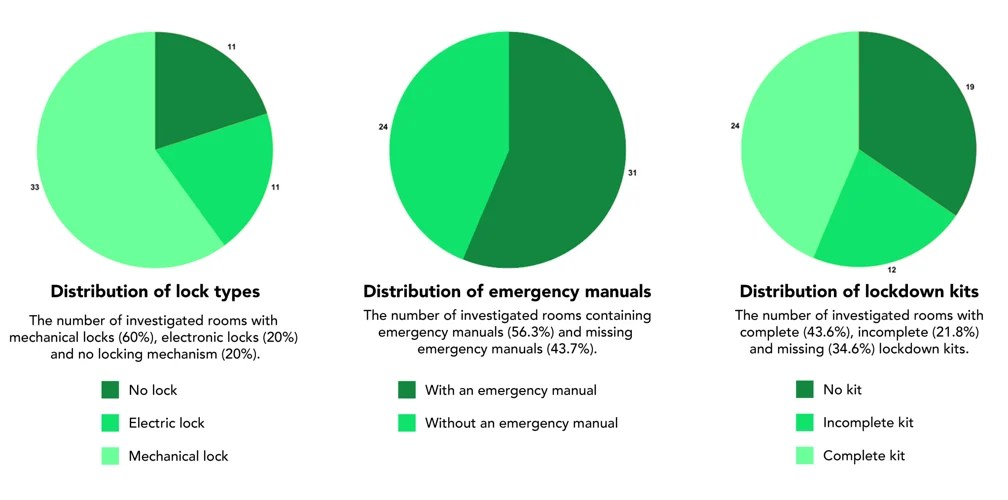
Following the University’s standards, nine rooms of the 55 the Niner Times examined are not properly equipped for a lockdown.
Mebane Hall
The Niner Times examined 20 unlocked rooms on the first three floors of Mebane, two of which had no lockdown kit.
Fifteen of these rooms were lockable, with nine having an electronic lock and six having a manual lock that did not require a key. All 15 lockable rooms had a lockdown kit.
The Niner Times found 19 total lockdown kits in Mebane, four of which were incomplete. Room 169 and 065 were missing instructions. Room 168 was missing a door wedge or fire hose, though the door has a manual lock. Room 037 was missing a door wedge or fire hose, though the door has an electronic lock.
Nine rooms in Mebane did not have an emergency manual.
Based on the University’s standards, two rooms are not properly equipped for a lockdown.
- Mebane 007: One double push door and two emergency exit doors that cannot be locked. Missing a lockdown kit
- Mebane 105 (study lounge): One door that cannot be locked. Missing a lockdown kit
Mebane 103 has a barricade box in addition to a lockdown kit. A barricade box is a small box next to the door handle that contains a rope that should be wrapped around the barricade box and the door handle to make the door harder to open. When testing the barricade box, the Niner Times found that the door was still able to be opened but only a few inches.
Mebane 062 had an additional “active shooter/active threat response kit.” This kit contained a seatbelt cutter and window hammer, rope, a rubber door stopper, EMS shears, hemostatic granules, gauze pads, entry/exit wound chest seals, a tourniquet and a wound wrap.
CHHS
The Niner Times examined 29 unlocked rooms on the first three floors of CHHS.
Twenty-four rooms had doors that were lockable from the inside. Two had electronic locks. Nine were lockable using a manual lock. Thirteen were lockable using a key. It is unclear whether professors receive keys to these doors or if these rooms would only be lockable by building staff.
Of the twenty-four lockable rooms, 13 still had lockdown kits.
Five rooms did not have lockable doors. Of these, three had lockdown kits, but only one was complete. Room 155 was missing a fire hose, and room 281 was missing instructions.
Seventeen rooms in CHHS did not have an emergency manual.
Based on University standards, three CHHS rooms are not properly equipped for a lockdown.
- CHHS 128 (student lounge): Three sets of double push doors that cannot be locked from the inside. Missing a lockdown kit
- CHHS 155: Three sets of double push doors, which would require six fire hoses. The lockdown kit only has five fire hoses.
- CHHS 376: Two doors that cannot be locked from the inside. Missing a lockdown kit
CHHS 124 had paper covering the windows on both doors that had not been present prior to the Feb. 1 incident.
Woodward Hall
The Niner Times examined six rooms on the first floor of Woodward.
Five of the rooms were only lockable with a key. The other room cannot be locked. Only one of the five lockable rooms had a lockdown kit.
Only two of the six rooms examined had lockdown kits. One kit was complete, and the other was missing instructions.
Five rooms were missing an emergency manual.
Based on the University’s standards, four rooms on the first floor of Woodward are not properly equipped for a lockdown.
- Woodward 125: Two doors that can only be locked with a key. Missing a lockdown kit
- Woodward 130: Two doors that can only be locked with a key. Missing a lockdown kit
- Woodward 135: Two doors that can only be locked with a key. Missing a lockdown kit
- Woodward 155: Two doors that can only be locked with a key. Missing a lockdown kit
Contact
claregrealey@gmail.com
LinkedIn

